Window-Mounted Auction Sticker VIN OCR
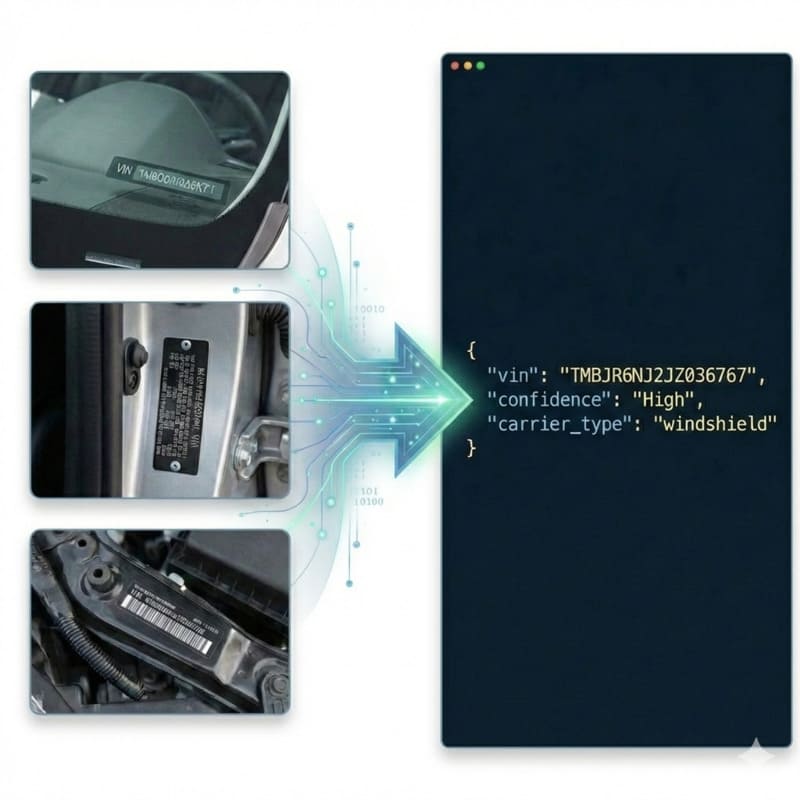
Conquer extreme visual noise and glass reflections. Accurately extract the tiny 17-character VIN from behind the windshield, completely ignoring oversized lot numbers and mileage prints.
200 free credits = 200 VIN scans, no credit card. Then from $5 for 500 credits, pay as you go. See pricing
The 'Needle in a Haystack' Through Glass
Scanning inventory tags placed on the inside of a vehicle's windshield presents a dual challenge for computer vision. First, there is the extreme text hierarchy discrepancy: auction tags feature massive, bold lot numbers, years, and mileage counts, while the actual VIN is printed in a tiny font near barcodes. Traditional OCR engines default to reading the largest text, outputting useless lot data. Second, shooting through curved automotive glass introduces severe environmental reflections—you often capture mirroring of the sky, clouds, or the inspector's own smartphone, which visually cuts through the small text. For a deeper dive into how we isolate specific data structures, see the VIN OCR API.
StructOCR: Built to Filter Noise and Glare
StructOCR doesn't rely on font size or top-to-bottom reading orders. Powered by our flagship Automotive VIN OCR engine, it actively hunts for the 17-character automotive structure. The neural network applies advanced de-glare pre-processing to neutralize the reflections of the sky and the camera lens on the glass. It explicitly ignores the oversized stock numbers, mileage, and barcodes, applying strict ISO 3779 validation to lock onto and extract only the true chassis sequence.
Live Demo: VIN Barcode Scanner
No registration required. Upload a file to test the extraction.
Drop files here or click to browse
JPG · PNG · PDF · TIFF · up to 500 files · max 4.5 MB each
Photograph the VIN plate at the bottom of the windshield or the label on the driver-side door jamb.
No document handy?
Core Industry Applications
Dealership Lot Audits
Quickly reconcile hundreds of vehicles on the lot. Staff can scan the window stickers from the outside without needing the keys to open the doors. Get 200 free credits to test your own inventory.To streamline your vehicle intake process without any integration, try capturing data effortlessly with our free VIN barcode scanner directly from your browser.
Wholesale Auction Dispatch
Transport drivers can rapidly verify the vehicles they are loading by scanning the windshield tags, ensuring the tiny VIN matches their eBOL dispatch orders.
Repossession & Recovery
Recovery agents can positively identify target vehicles from the outside by scanning the lot/auction sticker through the glass, even in challenging lighting conditions.
Digital Merchandising Intake
Automate vehicle listings. Scanning the window sticker immediately decodes the exact trim, engine, and specifications required for online marketplace syndication.
Technical Specs
- Visual Hierarchy Parsing: Designed to bypass dominant/oversized fonts to locate target structural data
- Validation: Built-in ISO 3779 rules & Length constraint (strictly 17 chars)
- Latency: < 1.2s per scan
- Data Privacy: Images kept for at most 24 hours for quality spot-checks, then deleted (SOC 2 Type II)
Key Features
- Glass Reflection Mitigation: Filters out environmental mirroring (sky, clouds, smartphones) on the windshield surface.
- Clutter Rejection: Automatically ignores massive lot numbers, dates, and vehicle mileage descriptions.
- Format Support: Accepts raw Base64 or Data URIs (JPG, PNG, WebP up to 4.5MB).
Integration & AI Prompts
Call the endpoint directly, or copy the prompt below into Cursor, Lovable, or v0 to instantly generate your frontend application.
import requests
import base64

# Get 200 free credits:
# 👉 https://structocr.com/register

# 1. Prepare Base64 Image
with open("window_auction_tag.jpg", "rb") as image_file:
    base64_image = base64.b64encode(image_file.read()).decode('utf-8')

url = "https://api.structocr.com/v1/vin"
headers = {
    "x-api-key": "YOUR_API_KEY",
    "Content-Type": "application/json"
}
payload = {
    "img": base64_image
}

try:
    print("Scanning Through-Glass Window Sticker...")
    response = requests.post(url, headers=headers, json=payload)
    result = response.json()

    if result.get('success'):
        data = result['data']
        print("✅ Extraction Successful!")
        print(f"VIN:          {data.get('vin')}")
        print(f"Confidence:   {data.get('confidence')}")
        print(f"Carrier Type: {data.get('carrier_type')}")
    else:
        print(f"❌ Extraction Failed: {result.get('error')} - {result.get('message')}")

except Exception as e:
    print(f"An error occurred: {e}")
Standardized JSON Output
The API returns a clean, structured payload containing the validated 17-character VIN, structural confidence, and identifies the carrier.
{
  "success": true,
  "data": {
    "vin": "1G1YB2E46E0123456",
    "confidence": "High",
    "carrier_type": "window_sticker"
  }
}
Frequently Asked Questions
Will the giant lot numbers and mileage on the tag confuse the API?
No. Unlike traditional OCR that reads everything, our engine utilizes strict structural searching based on ISO 3779 constraints. It actively ignores large 6-digit run numbers or mileage figures, isolating only the 17-character sequence.
What happens if the reflection of my phone covers part of the VIN?
Our models are trained heavily on 'in-the-wild' through-glass captures. While completely opaque reflections blocking the text cannot be read, our deep learning pipeline can often reconstruct characters partially obscured by light glare using built-in checksum validation.
Does the system scan the barcode next to the VIN?
Our API focuses on the optical character recognition (OCR) of the printed alphanumeric string, as barcodes on these temporary thermal tags are often too degraded or smudged to scan reliably through curved glass.
Explore More Automotive VIN OCR Solutions
Universal VIN OCR API Solution
Our flagship API for automated vehicle identification. Works across windshields, documents, and physical plates, with check-digit validation.
Auto Auction Sticker VIN OCR API
Extract 17-character VINs from barcode-bearing auto auction windshield stickers and dealership inventory tags, despite lot numbers, glare, and faded thermal print.
Auto Insurance Policy VIN OCR API
Extract 17-character VINs from highly variable auto insurance policies and ID cards. Template-free OCR that handles unstructured layouts and scanned faxes.
Auto Repair Invoice VIN OCR API
Extract 17-character VINs from auto repair orders and shop invoices. High-accuracy OCR that handles thermal paper, grease stains, and unstructured layouts.
Auto Transport BoL VIN OCR API
Extract multiple 17-character VINs simultaneously from vehicle transport Bills of Lading (BoL). High-accuracy OCR that parses dense logistics tables.
Cyrillic Vehicle Registration OCR API
Extract 17-character VINs from Cyrillic vehicle documents (like Russian STS). Advanced OCR eliminates visual homoglyph confusion between Cyrillic and Latin alphabets.
Digital Screen VIN OCR API
Extract 17-character VINs from photos of computer screens and digital monitors. High-accuracy OCR that eliminates Moiré patterns, pixelation, and screen glare.
Door Jamb Certification Label VIN OCR API
Extract 17-character VINs from barcode-bearing door jamb certification labels. High-accuracy OCR handles tire pressure, weight specs, grime, and dense vehicle data.
Door Jamb Compliance Label VIN OCR API
Extract 17-character VINs from door jamb safety certification labels. High-accuracy OCR that handles sideways images, complex compliance boilerplate, and varied lighting conditions.
Door Jamb Metal Plate VIN OCR API
Extract 17-character VINs and Frame Numbers from stamped metal door jamb plates. High-accuracy OCR that handles sideways images, metal glare, and low-contrast text.
GCC Compliance Plate VIN OCR API
Extract 17-character VINs from stamped GCC/Saudi vehicle compliance metal plates. High-accuracy OCR that handles painted metal glare, rivets, and Arabic boilerplate.
Technical Comparisons & Integrations
Explore platform integrations and competitive analysis
Add VIN OCR to Your Bolt.new App in 5 Minutes
Step-by-step guide to integrating the StructOCR VIN scanner API into a Bolt.new app. Build automotive and fleet tools right in your browser.
Add VIN OCR using Cursor in 5 Minutes
Step-by-step guide to integrating the StructOCR VIN scanner API using the Cursor AI code editor. Build automotive and fleet tools rapidly.
Add VIN OCR to Your Lovable.dev App in 5 Minutes
Step-by-step guide to integrating the StructOCR VIN scanner API into a Lovable.dev app. Build automotive and fleet tools with zero backend required.
OpenALPR vs. StructOCR API for VIN Decoding
Why traditional License Plate Recognition (ALPR) engines are not suitable for scanning Vehicle Identification Numbers (VINs).
Add VIN OCR to Your Replit App in 5 Minutes
Step-by-step guide to integrating the StructOCR VIN scanner API into a Replit application. Build automotive and fleet tools using Replit Agent and Secrets.
Add VIN OCR to Your v0 App in 5 Minutes
Step-by-step guide to integrating the StructOCR VIN scanner API into a v0 by Vercel app. Build automotive and fleet tools with zero backend.
From tutorial to production in 5 minutes.
You've seen the code. Now get your API key, grab your 200 free credits, and see it work with your own images. No credit card required.