Cyrillic Vehicle Registration (STS) VIN OCR
Automate vehicle border clearance and insurance underwriting in Eastern Europe and Central Asia. Accurately extract the 17-character VIN while flawlessly resolving visual homoglyphs between Cyrillic and Latin alphabets.
200 free credits = 200 VIN scans, no credit card. Then from $5 for 500 credits, pay as you go. See pricing
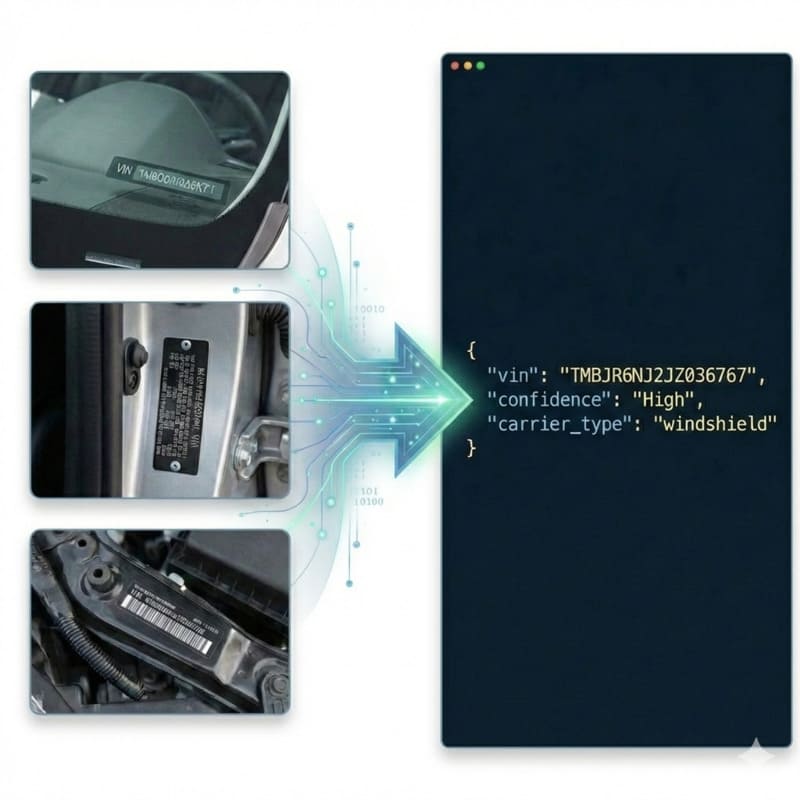
The Danger of Visual Homoglyphs
Processing vehicle registration documents from Eastern Europe and Central Asia (such as the Russian СТС - STS) introduces a severe OCR vulnerability known as 'Visual Homoglyphs.' Because the Cyrillic and Latin alphabets share characters that look visually identical but represent completely different letters—for example, the Cyrillic 'В' acts as a Latin 'V', and the Cyrillic 'У' resembles a Latin 'Y'—standard OCR engines frequently output corrupted, mixed-alphabet strings. When extracting a 17-character VIN from a document heavily populated with Cyrillic text, failing to aggressively enforce a Latin-only dictionary for the target string results in fatal downstream data validation errors. To see how our engine resolves complex linguistic contexts, explore the VIN OCR API.
Strict Latin Enforcement & Context Switching
StructOCR is designed to navigate the linguistic complexities of transcontinental vehicle trade as part of our Automotive VIN OCR suite. Our API utilizes context-aware bounding logic. Once it identifies the structural pattern of the international VIN, it forcibly switches to a strict Latin-and-Numeric dictionary. By applying rigid ISO 3779 validation rules, the engine guarantees that visually ambiguous characters are correctly parsed into their exact Latin counterparts, ensuring seamless integration into global databases without manual correction.
Live Demo: VIN Barcode Scanner
No registration required. Upload a file to test the extraction.
Drop files here or click to browse
JPG · PNG · PDF · TIFF · up to 500 files · max 4.5 MB each
Photograph the VIN plate at the bottom of the windshield or the label on the driver-side door jamb.
No document handy?
Core Industry Applications
Border Clearance & Customs Verification
Accelerate vehicle import processes across Eastern Europe and Central Asia. Instantly cross-reference the VIN from European imported used cars against international databases. Get 200 free credits to test your own transshipment documents.
Regional Insurance Underwriting
Eliminate manual policy setup errors. Allow policyholders to upload photos of their STS or registration certificates to instantly populate the application with a clean, validated alphanumeric VIN. Scaling your underwriting volume? Review our flexible pricing.
Cross-Border Fleet Management
Digitize paper-based transit and registration documents for logistics fleets crossing borders between EU and Cyrillic-alphabet jurisdictions, preventing compliance bottlenecks.
Used Vehicle Import Marketplaces
Accelerate seller onboarding for European used car imports by conducting automated background checks using the precisely extracted 17-character chassis number.
Technical Specs
- Homoglyph Resolution Engine: Specifically trained to prevent confusion between Cyrillic (В, У, С, etc.) and Latin (B, Y, C, etc.) characters within the VIN bounding box.
- Validation: Built-in ISO 3779 rules inherently block invalid character conversions.
- Glare & Lamination Immunity: Deep learning filters designed to parse heavily laminated wallet-sized cards.
- Data Privacy: Images kept for at most 24 hours for quality spot-checks, then deleted (SOC 2 Type II).
Key Features
- Target Output: Perfect extraction of the standard 17-character Latin VIN, entirely ignoring surrounding Cyrillic text.
- Regional Support: Seamlessly handles formats from Russia (STS), Ukraine, Kazakhstan, and other CIS nations.
- Format Flexibility: Accepts raw Base64 or direct file uploads (JPG, PNG, WebP up to 4.5MB).
Integration & AI Prompts
Bypass complex linguistic processing on your backend. Send the image to our API and receive a perfect, database-ready Latin string. Copy the prompt below to generate your frontend upload component.
import requests
import base64

# Get 200 free credits:
# 👉 https://structocr.com/register

# 1. Prepare Base64 Image of the Cyrillic Registration Document
with open("russian_sts_document.jpg", "rb") as image_file:
    base64_image = base64.b64encode(image_file.read()).decode('utf-8')

url = "https://api.structocr.com/v1/vin"
headers = {
    "x-api-key": "YOUR_API_KEY",
    "Content-Type": "application/json"
}
payload = {
    "img": base64_image
}

try:
    print("Scanning Cyrillic Vehicle Registration...")
    response = requests.post(url, headers=headers, json=payload)
    result = response.json()

    if result.get('success'):
        data = result['data']
        print("✅ Extraction Successful!")
        print(f"VIN (Pure Latin String): {data.get('vin')}")
        print(f"Confidence:              {data.get('confidence')}")
    else:
        print(f"❌ Extraction Failed: {result.get('error')} - {result.get('message')}")

except Exception as e:
    print(f"An error occurred: {e}")
Standardized JSON Output
The API acts as an automated normalization layer. Even if the document is entirely in Cyrillic, the returned VIN will be a 100% compliant, database-ready Latin alphanumeric string.
{
  "success": true,
  "data": {
    "vin": "WVWZZZ3CZAE123456",
    "confidence": "High",
    "carrier_type": "document"
  }
}
Frequently Asked Questions
How does the system avoid confusing the Cyrillic 'У' with the Latin 'Y' in the VIN?
Our engine utilizes strict dictionary enforcement based on ISO 3779. Since the letters I, O, and Q are never used in a standard VIN, and the system knows it is parsing an international vehicle identifier, it mathematically restricts the output to the valid subset of Latin characters and numbers, eliminating homoglyph confusion.
Does this support documents from countries other than Russia?
Yes. The context-aware bounding and homoglyph resolution engine works universally across documents from any country utilizing the Cyrillic alphabet, including Ukraine, Kazakhstan, Belarus, and other CIS states.
Can the API handle photos of small, laminated registration cards with heavy glare?
Absolutely. Documents like the Russian STS are notoriously small and heavily laminated. Our preprocessing pipeline automatically handles smartphone camera flash glare, shadows, and perspective distortions before extraction.
Explore More Automotive VIN OCR Solutions
Universal VIN OCR API Solution
Our flagship API for automated vehicle identification. Works across windshields, documents, and physical plates, with check-digit validation.
Digital Screen VIN OCR API
Extract 17-character VINs from photos of computer screens and digital monitors. High-accuracy OCR that eliminates Moiré patterns, pixelation, and screen glare.
Door Jamb Certification Label VIN OCR API
Extract 17-character VINs from barcode-bearing door jamb certification labels. High-accuracy OCR handles tire pressure, weight specs, grime, and dense vehicle data.
Door Jamb Compliance Label VIN OCR API
Extract 17-character VINs from door jamb safety certification labels. High-accuracy OCR that handles sideways images, complex compliance boilerplate, and varied lighting conditions.
Door Jamb Metal Plate VIN OCR API
Extract 17-character VINs and Frame Numbers from stamped metal door jamb plates. High-accuracy OCR that handles sideways images, metal glare, and low-contrast text.
GCC Compliance Plate VIN OCR API
Extract 17-character VINs from stamped GCC/Saudi vehicle compliance metal plates. High-accuracy OCR that handles painted metal glare, rivets, and Arabic boilerplate.
German Vehicle Registration OCR API
Extract 17-character VINs from German Zulassungsbescheinigung Teil I documents. Bypass holographic security and decode dense Field 'E' abbreviations effortlessly.
Indian RC Book OCR API
Extract Chassis Numbers (VINs) from Indian RC Books and Smart Cards. High-accuracy OCR designed to overcome micro-text, Hindi/English bilingual adhesion, and card damage.
Indonesian STNK OCR API
Extract VINs (Nomor Rangka) from Indonesian STNK documents. Specialized OCR engine engineered to decode faded dot-matrix printing and complex backgrounds.
Logistics Window Label VIN OCR API
Extract 17-character VINs from tiny transport labels on tinted vehicle windows. High-accuracy OCR that conquers distance, dark glass reflections, and heavy barcodes.
Metal Plate VIN OCR API
Extract 17-character VINs directly from engraved or stamped metal vehicle data plates. High-accuracy OCR that conquers metal glare, low contrast, and physical wear.
Technical Comparisons & Integrations
Explore platform integrations and competitive analysis
OpenALPR vs. StructOCR API for VIN Decoding
Why traditional License Plate Recognition (ALPR) engines are not suitable for scanning Vehicle Identification Numbers (VINs).
Add VIN OCR to Your Replit App in 5 Minutes
Step-by-step guide to integrating the StructOCR VIN scanner API into a Replit application. Build automotive and fleet tools using Replit Agent and Secrets.
Add VIN OCR to Your v0 App in 5 Minutes
Step-by-step guide to integrating the StructOCR VIN scanner API into a v0 by Vercel app. Build automotive and fleet tools with zero backend.
VIN Barcode Scanner vs. VIN OCR API: Which is Better for Mobile Apps?
Deciding between local VIN barcode scanners and cloud-based VIN OCR API for your mobile app? Learn why OCR is the required fallback for damaged or chassis-stamped VINs.
Apple Vision Framework / ML Kit vs. StructOCR VIN API
Why generic on-device text recognition frameworks fail at decoding VINs, and when to switch to a specialized automotive API.
Add VIN OCR to Your Bolt.new App in 5 Minutes
Step-by-step guide to integrating the StructOCR VIN scanner API into a Bolt.new app. Build automotive and fleet tools right in your browser.
From tutorial to production in 5 minutes.
You've seen the code. Now get your API key, grab your 200 free credits, and see it work with your own images. No credit card required.