UAE Vehicle Registration (Mulkiya) VIN OCR
Automate vehicle onboarding in the UAE. Accurately extract and validate the 17-character Chassis No. (رقم القاعدة) from complex, densely watermarked bilingual Mulkiya documents.
200 free credits = 200 VIN scans, no credit card. Then from $5 for 500 credits, pay as you go. See pricing
The Complexity of UAE Mulkiya Cards
UAE vehicle registration cards (Mulkiya) present a high-density, bilingual tabular layout. The primary obstacle is accurately locating the 'Chassis No.' (رقم القاعدة) amidst a mix of English and Arabic text, barcodes, and extremely dense background security watermarks. Standard OCR engines often fail to separate the foreground alphanumeric text from these intricate gold and yellow background patterns, leading to misread characters. For a deeper dive into how we handle complex backgrounds, see the VIN OCR API.
StructOCR: Built for Dense Tabular Layouts
StructOCR intelligently maps the bilingual key-value pairs, completely ignoring the heavy security patterns, stamps, and barcodes found on UAE registration cards. Powered by our flagship Automotive VIN OCR engine, it extracts the exact 17-character string. It doesn't just read text; it applies strict ISO 3779 validation. The system automatically normalizes characters to uppercase, strips non-alphanumeric noise, and auto-corrects common visual misidentifications (e.g., converting the letter 'O' or 'Q' to the number '0'). Need every field, such as the plate, owner, engine number, vehicle class and weights? See full-field Mulkiya OCR.
Live Demo: VIN Barcode Scanner
No registration required. Upload a file to test the extraction.
Drop files here or click to browse
JPG · PNG · PDF · TIFF · up to 500 files · max 4.5 MB each
Photograph the VIN plate at the bottom of the windshield or the label on the driver-side door jamb.
No document handy?
Core Industry Applications
Automotive Insurance (Takaful) Onboarding
Instantly pre-fill policy applications by extracting the validated VIN directly from the policyholder's uploaded Mulkiya card. Get 200 free credits to test your own documents.To streamline your vehicle intake process without any integration, try capturing data effortlessly with our free VIN barcode scanner directly from your browser.
GCC Cross-Border Fleet Logistics
Streamline customs and fleet management across the UAE and greater GCC region by automating the digitization of official registration documents.
Used Car Marketplaces
Accelerate seller onboarding by conducting automated background checks and RTA history lookups using the precisely extracted 17-character Chassis Number.
Auto Repair & Dealership Servicing
Eliminate manual data entry errors. Scan the customer's Mulkiya to instantly retrieve the exact VIN required for ordering OEM parts and verifying service contracts.
Technical Specs
- Validation: Built-in ISO 3779 rules & Length constraint (strictly 17 chars)
- Auto-Correction: Resolves I/1, O/0, Q/0 ambiguities automatically
- Latency: < 1.2s per document
- Data Privacy: Images kept for at most 24 hours for quality spot-checks, then deleted (SOC 2 Type II)
Key Features
- Chassis Number (رقم القاعدة): Perfect extraction of the standard VIN despite nearby barcodes and stamps.
- Background Filtering: Specially trained to drop out dense Mulkiya security watermarks.
- Format Support: Accepts raw Base64 or Data URIs (JPG, PNG, WebP up to 4.5MB).
Integration & AI Prompts
Call the endpoint directly, or copy the prompt below into Cursor, Lovable, or v0 to instantly generate your frontend application.
import requests
import base64

# Get 200 free credits:
# 👉 https://structocr.com/register

# 1. Prepare Base64 Image
with open("uae_mulkiya.jpg", "rb") as image_file:
    base64_image = base64.b64encode(image_file.read()).decode('utf-8')

url = "https://api.structocr.com/v1/vin"
headers = {
    "x-api-key": "YOUR_API_KEY",
    "Content-Type": "application/json"
}
payload = {
    "img": base64_image
}

try:
    print("Scanning UAE Mulkiya Card...")
    response = requests.post(url, headers=headers, json=payload)
    result = response.json()

    if result.get('success'):
        data = result['data']
        print("\u2705 Extraction Successful!")
        print(f"VIN:          {data.get('vin')}")
        print(f"Confidence:   {data.get('confidence')}")
        print(f"Carrier Type: {data.get('carrier_type')}")
    else:
        print(f"\u274c Extraction Failed: {result.get('error')} - {result.get('message')}")

except Exception as e:
    print(f"An error occurred: {e}")
Standardized JSON Output
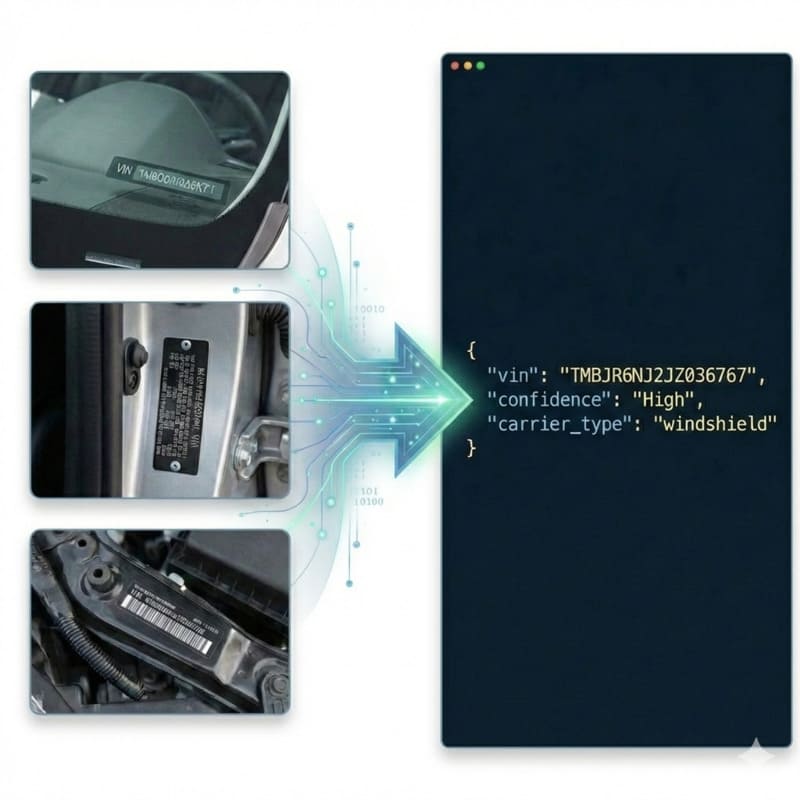
The API returns a clean, structured payload containing the validated 17-character VIN, structural confidence, and the detected carrier type.
{
  "success": true,
  "data": {
    "vin": "WA1UABAG1JX123456",
    "confidence": "High",
    "carrier_type": "document"
  }
}
Frequently Asked Questions
Does the system get confused by the barcodes or stamps on the Mulkiya?
No. Our visual grounding models are trained to anchor specifically to the 'Chassis No.' / 'رقم القاعدة' tabular fields, completely bypassing the visual noise caused by official stamps or licensing barcodes.
What happens if the chassis number on the card has a typo or blurry character?
Our engine utilizes built-in ISO 3779 logic. If a character like the letter 'O' is visually present where a number should be, the system automatically corrects it to '0' based on the VIN structural requirements.
What image formats and sizes are supported?
The API accepts JPG, PNG, and WebP formats. Images can be sent as direct URLs or Base64 encoded strings, with a maximum payload size of 4.5MB.
Explore More Automotive VIN OCR Solutions
Universal VIN OCR API Solution
Our flagship API for automated vehicle identification. Works across windshields, documents, and physical plates, with check-digit validation.
US DMV Title VIN OCR API
Extract 17-character VINs from US DMV Titles across all 50 states. High-accuracy OCR that bypasses security paper backgrounds and dot-matrix print.
UK V5C Logbook VIN OCR API
Extract 17-character VINs from UK DVLA V5C registration certificates. High-accuracy API that parses logbook layouts and ignores complex security backgrounds.
Vietnam Vehicle Registration VIN OCR API
Extract 17-character VINs (Số khung) from Vietnamese registration cards. High-accuracy OCR engineered to handle red stamps, moiré patterns, and screen captures.
Windshield VIN OCR API
Extract 17-character VINs directly from vehicle windshields. High-accuracy OCR that automatically filters out severe glass glare, reflections, and dirt.
Arabic Vehicle Registration VIN OCR API
Extract 17-character VINs (Chassis Numbers) from Arabic registration cards. High-accuracy OCR featuring ISO 3779 validation and auto-correction.
Auction Window Sticker VIN OCR API
Extract 17-character VINs from inventory tags placed behind vehicle windshields. High-accuracy OCR that ignores massive lot numbers and filters out glass reflections.
Auto Auction Sticker VIN OCR API
Extract 17-character VINs from barcode-bearing auto auction windshield stickers and dealership inventory tags, despite lot numbers, glare, and faded thermal print.
Auto Insurance Policy VIN OCR API
Extract 17-character VINs from highly variable auto insurance policies and ID cards. Template-free OCR that handles unstructured layouts and scanned faxes.
Auto Repair Invoice VIN OCR API
Extract 17-character VINs from auto repair orders and shop invoices. High-accuracy OCR that handles thermal paper, grease stains, and unstructured layouts.
Auto Transport BoL VIN OCR API
Extract multiple 17-character VINs simultaneously from vehicle transport Bills of Lading (BoL). High-accuracy OCR that parses dense logistics tables.
Technical Comparisons & Integrations
Explore platform integrations and competitive analysis
Add VIN OCR to Your Replit App in 5 Minutes
Step-by-step guide to integrating the StructOCR VIN scanner API into a Replit application. Build automotive and fleet tools using Replit Agent and Secrets.
Add VIN OCR to Your v0 App in 5 Minutes
Step-by-step guide to integrating the StructOCR VIN scanner API into a v0 by Vercel app. Build automotive and fleet tools with zero backend.
VIN Barcode Scanner vs. VIN OCR API: Which is Better for Mobile Apps?
Deciding between local VIN barcode scanners and cloud-based VIN OCR API for your mobile app? Learn why OCR is the required fallback for damaged or chassis-stamped VINs.
Apple Vision Framework / ML Kit vs. StructOCR VIN API
Why generic on-device text recognition frameworks fail at decoding VINs, and when to switch to a specialized automotive API.
Add VIN OCR to Your Bolt.new App in 5 Minutes
Step-by-step guide to integrating the StructOCR VIN scanner API into a Bolt.new app. Build automotive and fleet tools right in your browser.
Add VIN OCR using Cursor in 5 Minutes
Step-by-step guide to integrating the StructOCR VIN scanner API using the Cursor AI code editor. Build automotive and fleet tools rapidly.
From tutorial to production in 5 minutes.
You've seen the code. Now get your API key, grab your 200 free credits, and see it work with your own images. No credit card required.