Stationary vs. Mobile ALPR Cameras: Which OCR Tech Do You Need?
Whether capturing plates from a moving patrol car or a fixed highway gantry, the hardware is only half the equation. Learn why a hardware-agnostic OCR API is the ultimate backend for any deployment.
200 free credits = 200 License Plate scans, no credit card. Then from $5 for 500 credits, pay as you go. See pricing
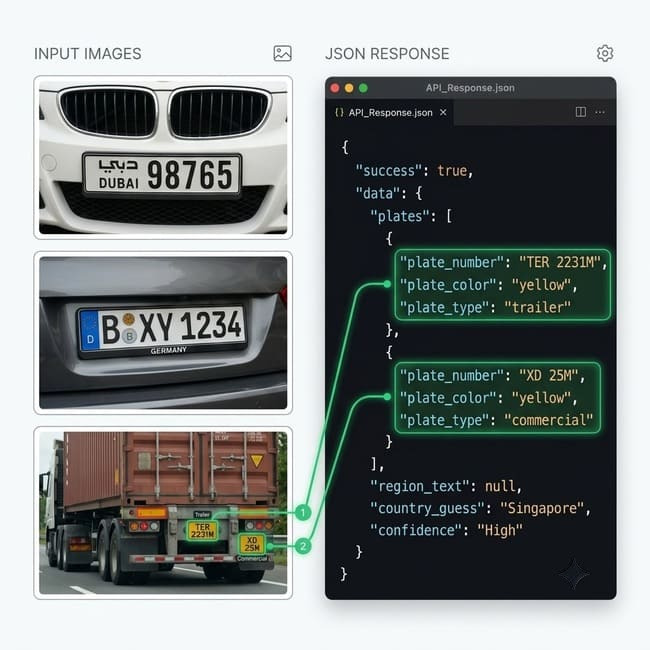
The Environmental Challenges of Different Hardware
When designing an alpr camera system, developers must choose between mobile alpr cameras (like police dashcams or smartphone scanning apps) and stationary license plate readers (such as parking gates or highway gantries). Mobile systems inherently suffer from severe motion blur, unpredictable lighting, and sharp off-axis shooting angles as the camera moves through the environment. Stationary systems, while fixed, often battle with high-speed shutter limitations, headlight glare, and IR washout at night. Regardless of the hardware, local processing models often struggle with these variables. Before investing heavily in specialized lenses or proprietary NVRs, you can test your real-world captures against our API for free to see how a dedicated engine cleans up noisy images.
The Solution: A Hardware-Agnostic OCR Backend
The secret to a highly accurate alpr camera system isn't just the physical lens—it's the backend image parsing capability. The StructOCR License Plate API is completely hardware-agnostic. It does not matter if the image originates from an expensive LPR camera or a basic smartphone used by a parking attendant. By securely uploading raw files or Base64 strings directly to our endpoints, your application offloads the intense computational filtering required to extract accurate text from both mobile and stationary feeds.
Live Demo: License Plate OCR Scanner
No registration required. Upload a file to test the extraction.
Drop files here or click to browse
JPG · PNG · PDF · TIFF · up to 500 files · max 4.5 MB each
No document handy?
One API, Multiple Hardware Deployments
Mobile Parking Enforcement Apps
Equip parking attendants with standard smartphones. The app captures the plate, and the cloud API handles the extraction, ignoring motion blur from walking.
Stationary Gate Access & Tolling
Process images from fixed RTSP cameras at community gates. Connect your backend logic swiftly using standard HTTP requests or our official Python SDK wrapper.
Fleet & Repossession Vehicles
Dashcams mounted on moving tow trucks can continuously ping our API with frames to cross-reference against hotlists in real-time.
Drive-Thru & Retail Analytics
Use stationary cameras to identify returning loyalty customers at the drive-thru. View flexible pricing to scale this seamlessly across thousands of franchise locations.
Technical Specs
- Dynamic Visual Filtering: Our AI models automatically apply de-blurring and contrast adjustments optimized for both mobile camera shake and stationary IR glare.
- Input Versatility: Fully supports raw Base64 strings up to 4.5MB, direct file uploads, and public URLs—allowing your frontend devices to dictate how data is passed.
- Edge Optimization: Deployed on Cloudflare, ensuring that mobile devices on 4G networks or fixed cameras on fiber lines both receive millisecond processing latency.
- Multi-Dimensional Data: Extracts the primary alphanumeric string while strictly categorizing vital metadata like `plate_color` and `plate_type`.
Key Features
- Zero Hardware Lock-In: Never get stuck paying premium prices for a specific manufacturer's camera just to use their proprietary OCR software.
- Unified Backend: Manage data from your patrol cars and your fixed parking garages in the exact same JSON format, simplifying your database architecture.
- Future-Proofing: As smartphone cameras and IP cameras evolve, your OCR backend instantly benefits without requiring any software updates on your end.
Universal Integration: Just 15 Lines of Code
Whether your payload comes from an iOS app or a fixed NVR, the API integration remains identical. Check the API documentation for full payload parameters and schema details.
import requests
import base64

# Prepare Base64 Image to extract License Plate data
with open("vehicle_capture.jpg", "rb") as image_file:
    base64_image = base64.b64encode(image_file.read()).decode('utf-8')

url = "https://api.structocr.com/v1/license-plate"
headers = {
    "x-api-key": "YOUR_API_KEY",
    "Content-Type": "application/json"
}
payload = {
    "img": base64_image
}

try:
    print("Analyzing vehicle plates...")
    response = requests.post(url, headers=headers, json=payload)
    result = response.json()

    if result.get('success'):
        data = result['data']
        plates = data.get('plates', [])
        print(f"✅ Successfully detected {len(plates)} plate(s)!")
        for idx, plate in enumerate(plates):
            print(f"[{idx+1}] Number: {plate.get('plate_number')} (Normalized: {plate.get('plate_number_normalized')}) | Type: {plate.get('plate_type')} | Color: {plate.get('plate_color')}")
        print(f"Country Guess: {data.get('country_guess')} | Confidence: {data.get('confidence_score')}")
    else:
        print(f"❌ Extraction Failed: {result.get('error') or result.get('message')}")

except Exception as e:
    print(f"An error occurred: {e}")
Standardized JSON Output
A single API call returns a structured response that gracefully handles complex layouts, providing you with clean data regardless of the camera's form factor.
{
  "success": true,
  "data": {
    "plates": [
      {
        "plate_number": "TRE 1631M",
        "plate_number_normalized": "TRE1631M",
        "plate_color": "yellow",
        "plate_type": "trailer"
      },
      {
        "plate_number": "XB 98X",
        "plate_number_normalized": "XB98X",
        "plate_color": "yellow",
        "plate_type": "commercial"
      }
    ],
    "region_text": null,
    "country_guess": "Singapore",
    "confidence_score": 0.99
  }
}
Frequently Asked Questions
Do I need a specialized LPR camera to use this API?
No. While specialized LPR cameras help produce clearer images at night due to IR sensors, our API is designed to process standard JPEGs from any modern IP camera, smartphone, or dashcam.
How does the API handle severe motion blur from mobile cameras?
Our cloud engine utilizes advanced deep learning models trained specifically on sub-optimal, real-world footage. It mathematically infers and reconstructs characters from blurred images much more effectively than lightweight edge models.
Does the API support international license plates and non-Latin scripts?
Yes. Our global ALPR engine is trained to recognize a wide variety of international plate formats and natively extracts non-Latin characters, including Arabic, Cyrillic, and Asian scripts. Because our infrastructure is deployed on a global edge network, you will experience ultra-low latency processing regardless of where your cameras or servers are located in the world.
Explore More License-plate Solutions
Thai License Plate OCR API: Extract Native Scripts
Struggling with an OpenALPR Thai setup? Our global OCR number plate recognition API perfectly extracts native Thai scripts, province names, and color codes.
Vietnam ALPR & Motorcycle Plate Recognition API
Need reliable Vietnam ALPR for high-density motorcycle traffic? Our OCR API instantly extracts two-line square plates, plate colors, and vehicle types despite severe glare.
Arabic License Plate OCR API: Extract Non-Latin Scripts
Struggling with an OpenALPR Arabic setup? Our global OCR number plate recognition API perfectly extracts native Middle Eastern scripts, dual-layouts, and numerals.
Adding ALPR to Blue Iris & ZoneMinder: 2026 API Guide (Free Test)
Upgrade your VMS with Blue Iris ALPR or ZoneMinder ALPR. Learn how to send camera ALPR motion frames to our Cloud API for instant, low-cost license plate recognition.
ALPR for Law Enforcement: Tech Overview & API Backend
Discover how license plate readers for law enforcement power patrol cars and checkpoints. Integrate our high-speed ALPR API into your security systems today.
Legacy ALPR vs Modern APIs: Genetec & 3M Alternatives
Comparing ALPR system costs? Ditch expensive hardware bundles from Genetec, 3M, and Leonardo Elsag. Discover our hardware-agnostic ALPR cloud API for modern SaaS.
OpenALPR Pricing Guide & Best API Alternative (2026)
Navigating OpenALPR pricing? Compare Rekor OpenALPR costs and discover our scalable, cost-effective cloud API alternative. Supports crypto and global payments.
Python License Plate Recognition: OpenCV vs API (Free Test)
Building an OpenCV number plate recognition system? Compare traditional Python models with our ALPR Cloud API. Upload your car plate images for a free OCR test.
Raspberry Pi ALPR: Docker Images vs API (Free Test)
Struggling with slow ALPR Docker images on your Raspberry Pi? Switch to our lightweight cloud OCR API for instant recognition. Free image testing available.
Technical Comparisons & Integrations
Explore platform integrations and competitive analysis
Add National ID OCR to Your Bolt.new App in 5 Minutes
Step-by-step guide to integrating the StructOCR National ID scanner API into a Bolt.new app. Build KYC and identity verification flows right in your browser.
Add Passport OCR to Your Bolt.new App in 5 Minutes
Step-by-step guide to integrating the StructOCR Passport scanner API into a Bolt.new app. Build travel, hospitality, and global KYC flows right in your browser.
Add Receipt OCR to Your Bolt.new App in 5 Minutes
Step-by-step guide to integrating the StructOCR receipt API into a Bolt.new app. Build expense tracking and receipt scanning tools right in your browser.
Add VIN OCR to Your Bolt.new App in 5 Minutes
Step-by-step guide to integrating the StructOCR VIN scanner API into a Bolt.new app. Build automotive and fleet tools right in your browser.
Add Container OCR using Cursor in 5 Minutes
Step-by-step guide to integrating the StructOCR shipping container API using the Cursor AI code editor. Build logistics and yard management tools rapidly.
Add Driver's License OCR using Cursor in 5 Minutes
Step-by-step guide to integrating the StructOCR Driver's License scanner API using the Cursor AI code editor. Build car rental and mobility onboarding flows rapidly.
From tutorial to production in 5 minutes.
You've seen the code. Now get your API key, grab your 200 free credits, and see it work with your own images. No credit card required.