Thai License Plate OCR API: Overcoming Non-Latin Character Challenges
Standard ALPR engines struggle with Southeast Asian plates. Discover a global OCR API built to extract native Thai scripts, two-line province layouts, and color-coded vehicle types flawlessly.
200 free credits = 200 License Plate scans, no credit card. Then from $5 for 500 credits, pay as you go. See pricing
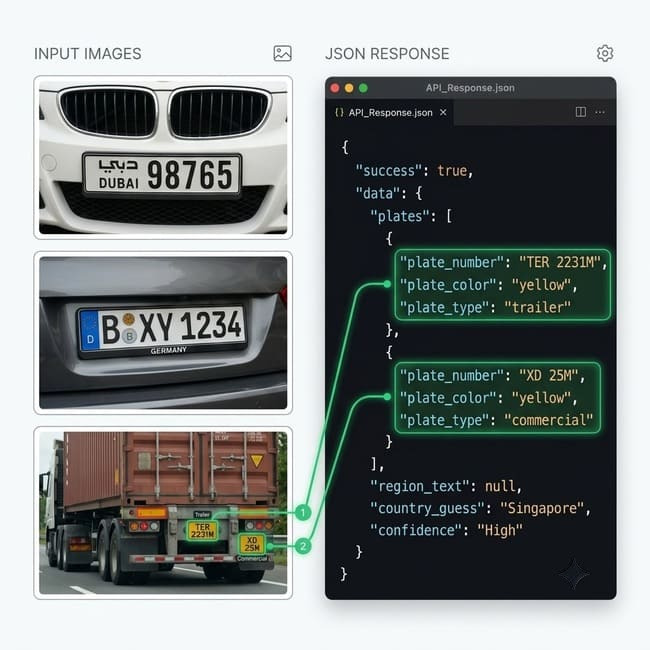
The Complexity of Thai License Plates
For system integrators and cross-border logistics companies operating in Southeast Asia, implementing robust ocr number plate recognition presents unique technical hurdles. Standard western-trained models—such as a default openalpr thai configuration—often fail to comprehend the typographic density and specific layouts of these plates. Thai plates heavily feature complex, looping non-Latin characters, utilize a dense two-line format where the bottom line specifies the province, and rely heavily on background colors (white, yellow, green, red) to designate vehicle class. Attempting to train self-hosted models to distinguish these elements often results in awkward transliterations or complete recognition failures. Before spending months collecting local datasets, you can test your regional captures against our API for free to experience true native-script extraction.
A Global Engine for Native Script Retention
The StructOCR License Plate API is engineered specifically to transcend the limitations of Latin-only models. Rather than forcing transliterations, our backend perfectly retains native Thai scripts and accurately reads the secondary province text exactly as it appears. Deployed on Cloudflare's global edge network, the API ensures that whether your camera is in Bangkok, Chiang Mai, or a border checkpoint, the image is processed by the nearest geographic node for ultra-low latency.
Live Demo: License Plate OCR Scanner
No registration required. Upload a file to test the extraction.
Drop files here or click to browse
JPG · PNG · PDF · TIFF · up to 500 files · max 4.5 MB each
No document handy?
Empowering Southeast Asian System Integrators
Cross-Border ASEAN Logistics
Seamlessly track commercial trucks moving across borders in Southeast Asia. The API accurately reads diverse national formats without requiring manual country selection.
Smart City & Toll Automation
Local integrators can power high-speed automated tolling systems by relying on our engine to instantly distinguish between private (white) and commercial (yellow) plates.
Rapid System Integration
Skip the legacy enterprise manuals. Integrate in minutes using standard HTTP requests or streamline your backend using our official Python SDK wrapper.
Frictionless Global Payments
Scaling your SaaS internationally? View flexible pricing that eliminates cross-border financial friction for Asian clients by natively supporting Paddle, USDT, and USDC payment gateways.
Technical Specs
- Native Character Retention: Completely avoids forced transliteration algorithms, ensuring that Thai scripts are returned exactly as printed on the physical plate.
- Edge Optimization: Infrastructure is deployed on Cloudflare, ensuring that API requests originating from Southeast Asia are processed by local geographic edge nodes for maximum speed.
- Input Versatility: Fully supports raw Base64 strings up to 4.5MB, direct file uploads, and public URLs—giving you complete control over how you handle cross-border sensitive image streams.
- Language Agnostic Integration: We offer pure REST APIs, eliminating dependency conflicts and allowing seamless integration into any tech stack from Python to Go.
Key Features
- Dual-Line Mastery: Automatically detects and structures complex plates, perfectly separating the main alphanumeric identifier from the province name written below it.
- Color & Type Intelligence: Automatically extracts `plate_color` (e.g., yellow for taxis, green for limousines) and correlates it to the `plate_type` enum, delivering deep context for your software.
- Reliable JSON Architecture: Outputs highly structured data instead of loose string arrays, isolating the main plate number from regional text for cleaner database logging.
Extracting Thai Plates: Just 15 Lines of Code
Call the endpoint directly using Python's standard `requests` library. The engine natively supports flexible inputs: you can utilize standard image URLs, direct file uploads, or raw Base64-encoded strings. Check the API documentation for full payload parameters and schema details.
import requests
import base64

# Prepare Base64 Image to extract License Plate data
with open("bangkok_plate_capture.jpg", "rb") as image_file:
    base64_image = base64.b64encode(image_file.read()).decode('utf-8')

url = "https://api.structocr.com/v1/license-plate"
headers = {
    "x-api-key": "YOUR_API_KEY",
    "Content-Type": "application/json"
}
payload = {
    "img": base64_image
}

try:
    print("Analyzing Southeast Asian vehicle plates...")
    response = requests.post(url, headers=headers, json=payload)
    result = response.json()

    if result.get('success'):
        data = result['data']
        plates = data.get('plates', [])
        print(f"✅ Successfully detected {len(plates)} plate(s)!")
        for idx, plate in enumerate(plates):
            print(f"[{idx+1}] Number: {plate.get('plate_number')} (Normalized: {plate.get('plate_number_normalized')}) | Type: {plate.get('plate_type')} | Color: {plate.get('plate_color')}")
        print(f"Country Guess: {data.get('country_guess')}")
        print(f"Region Text: {data.get('region_text')} | Confidence: {data.get('confidence_score')}")
    else:
        print(f"❌ Extraction Failed: {result.get('error') or result.get('message')}")

except Exception as e:
    print(f"An error occurred: {e}")
Standardized JSON Output (Thailand Example)
A single API call returns a structured response that gracefully handles complex Thai layouts, isolating the core number from the province descriptor.
{
  "success": true,
  "data": {
    "plates": [
      {
        "plate_number": "1ขร 9999",
        "plate_number_normalized": "1ขร9999",
        "plate_color": "white",
        "plate_type": "private"
      }
    ],
    "region_text": "กรุงเทพมหานคร",
    "country_guess": "Thailand",
    "confidence_score": 0.98
  }
}
Frequently Asked Questions
How does your pricing compare to standard OpenALPR pricing?
While traditional OpenALPR pricing often involves high monthly minimums or per-camera software licenses for local agents, we operate on a strict pay-as-you-go model. You only pay for the API requests you actually make, which is drastically cheaper for variable traffic.
I am an international developer. Can I pay with cryptocurrency?
Yes. We understand that global developers face high cross-border credit card friction. To solve this, we accept USDT and USDC payments alongside traditional fiat gateways via Paddle, allowing you to fund your API credits instantly.
Does the API support international license plates and non-Latin scripts?
Yes. Our global ALPR engine is trained to recognize a wide variety of international plate formats and natively extracts non-Latin characters, including Arabic, Thai, Cyrillic, and other Asian scripts. Because our infrastructure is deployed on a global edge network, you will experience ultra-low latency processing regardless of where your cameras or servers are located in the world.
Explore More License-plate Solutions
Vietnam ALPR & Motorcycle Plate Recognition API
Need reliable Vietnam ALPR for high-density motorcycle traffic? Our OCR API instantly extracts two-line square plates, plate colors, and vehicle types despite severe glare.
Arabic License Plate OCR API: Extract Non-Latin Scripts
Struggling with an OpenALPR Arabic setup? Our global OCR number plate recognition API perfectly extracts native Middle Eastern scripts, dual-layouts, and numerals.
Adding ALPR to Blue Iris & ZoneMinder: 2026 API Guide (Free Test)
Upgrade your VMS with Blue Iris ALPR or ZoneMinder ALPR. Learn how to send camera ALPR motion frames to our Cloud API for instant, low-cost license plate recognition.
ALPR for Law Enforcement: Tech Overview & API Backend
Discover how license plate readers for law enforcement power patrol cars and checkpoints. Integrate our high-speed ALPR API into your security systems today.
Legacy ALPR vs Modern APIs: Genetec & 3M Alternatives
Comparing ALPR system costs? Ditch expensive hardware bundles from Genetec, 3M, and Leonardo Elsag. Discover our hardware-agnostic ALPR cloud API for modern SaaS.
OpenALPR Pricing Guide & Best API Alternative (2026)
Navigating OpenALPR pricing? Compare Rekor OpenALPR costs and discover our scalable, cost-effective cloud API alternative. Supports crypto and global payments.
Python License Plate Recognition: OpenCV vs API (Free Test)
Building an OpenCV number plate recognition system? Compare traditional Python models with our ALPR Cloud API. Upload your car plate images for a free OCR test.
Raspberry Pi ALPR: Docker Images vs API (Free Test)
Struggling with slow ALPR Docker images on your Raspberry Pi? Switch to our lightweight cloud OCR API for instant recognition. Free image testing available.
Stationary vs Mobile ALPR Cameras: OCR Backend Guide
Comparing mobile ALPR cameras and stationary license plate readers? Discover how our hardware-agnostic OCR API powers any ALPR camera system with ease.
Technical Comparisons & Integrations
Explore platform integrations and competitive analysis
Add Receipt OCR to Your Replit App in 5 Minutes
Step-by-step guide to integrating the StructOCR receipt API into a Replit application. Build expense tracking and receipt scanning tools using Replit Agent and Secrets.
Add VIN OCR to Your Replit App in 5 Minutes
Step-by-step guide to integrating the StructOCR VIN scanner API into a Replit application. Build automotive and fleet tools using Replit Agent and Secrets.
Single-Page MRZ SDKs vs. Dual-Page Indian KYC API
Why traditional MRZ scanners fail at full Indian Passport verification, and how to process both the front identity page and the back address page in a single API call.
Template-Based OCR vs. StructOCR API for Invoice Processing
Why traditional zonal/template-based OCR fails at processing vendor invoices, and how layout-agnostic AI APIs instantly extract line items and totals.
Tesseract & PassportEye vs. StructOCR Passport API
A technical evaluation for developers deciding between open-source MRZ scanners and a dedicated cloud-based Passport OCR API.
Tesseract OCR vs. StructOCR API for ISO 6346 Container Numbers
A technical comparison for developers evaluating open-source Tesseract vs. a dedicated cloud API for extracting shipping container numbers.
From tutorial to production in 5 minutes.
You've seen the code. Now get your API key, grab your 200 free credits, and see it work with your own images. No credit card required.