Add National ID OCR to Your v0 App in 5 Minutes
v0 scaffolds your React UI. StructOCR reads the identity cards. Here's the exact prompt and API call to wire them together for instant KYC — zero backend required.
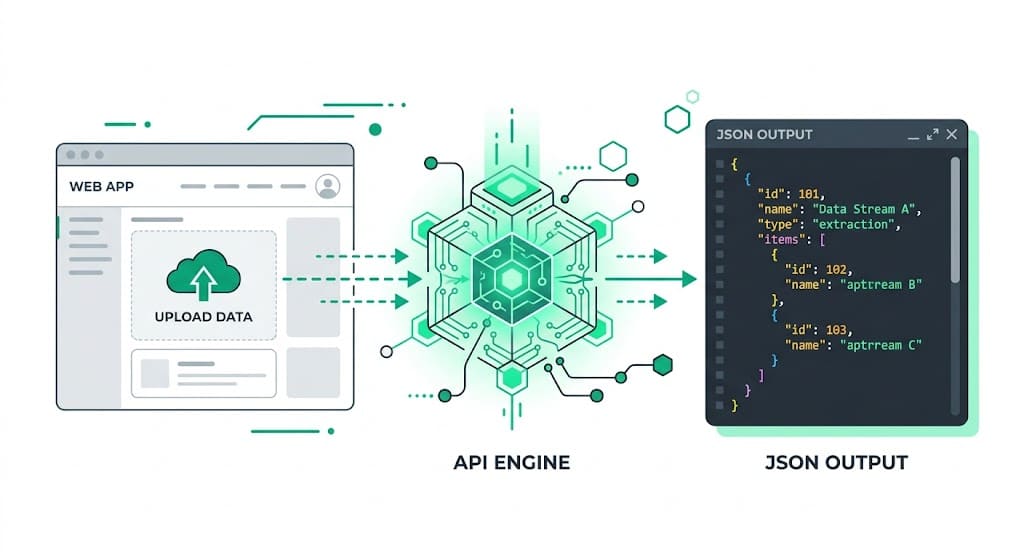
Why v0 + StructOCR is a natural fit for Identity Verification
v0 generates beautiful, accessible React interfaces using Tailwind CSS and shadcn/ui directly from plain English. It handles the frontend components perfectly — but securely extracting names, birth dates, and MRZ codes from a laminated ID card photo is something you have to wire up yourself. StructOCR fills exactly that gap: one API call, structured JSON back. Tell v0 what you want, paste in the fetch code below, and your onboarding flow is ready.
The problem: Standard AI hallucinates PII and fails on holograms
Tools like v0 are remarkable at generating UIs instantly — but they stop at the file boundary. You can build a beautiful KYC upload interface in minutes, yet the actual extraction of names, document numbers, and MRZ lines from a laminated ID card requires a dedicated National ID OCR API. Standard vision models routinely misread security fonts, hallucinate personal data, or fail entirely on holographic overlays and glare.
The solution: Global ID parsing, instantly
StructOCR's /v1/national-id endpoint accepts a photo and returns a clean JSON object with the validated identity fields. It automatically decodes Machine Readable Zones (MRZ) and handles complex, localized ID layouts. Because it speaks plain HTTP, v0 can wire it up from a single fetch call.
Integrate StructOCR in v0 (3 Steps)
Create a v0 project and describe your app
Open v0.dev and start a new prompt. Describe the identity verification tool you want to build — be specific about the fields you need.
Try this prompt: "Build a mobile-friendly KYC onboarding UI using shadcn. Users can upload a photo of their National ID card, and the app will display the extracted full name, document number, date of birth, and address in a clean card."Tell v0 to call the StructOCR API
Once v0 scaffolds the UI, paste the follow-up prompt below. v0 will update the React code to handle the file upload and wire the API response to your UI components.
Follow-up prompt: "When a user uploads an image, send it as a multipart/form-data POST to https://api.structocr.com/v1/national-id with an Authorization header containing my API key. Display the returned JSON fields in the results panel."// v0 generates something like this in your React component const response = await fetch('https://api.structocr.com/v1/national-id', { method: 'POST', headers: { Authorization: `Bearer ${process.env.NEXT_PUBLIC_STRUCTOCR_KEY}` }, body: formData, });Add your StructOCR API key
When you export your v0 project to a Next.js codebase or deploy to Vercel, simply add your StructOCR key to your .env.local file or Vercel Environment Variables.
Variable name: NEXT_PUBLIC_STRUCTOCR_KEY — get your free key at structocr.com/dashboardNEXT_PUBLIC_STRUCTOCR_KEY=sk_live_xxxxxxxxxxxxxxxx
What you can build in v0 with this integration
- Fintech onboarding (KYC): Let users snap a photo of their ID to instantly populate sign-up forms without manual typing, drastically reducing drop-off rates in financial onboarding flows.
- Gig economy driver signup: Build a mobile portal where contractors upload their ID cards for instant identity verification, a crucial step for mobility and delivery apps.
- Age verification gates: Create a tool that scans a user's ID, calculates their age based on the extracted `date_of_birth`, and conditionally grants access to age-restricted goods or services.
- Visitor management systems: Add an upload step to a corporate check-in flow: extract visitor details automatically from their national ID to print temporary badges in seconds.
The prompt and the code
Copy the follow-up prompt into your v0 chat to generate the integration. The code block shows what v0 typically produces — useful if you want to verify or customize it.
Prerequisite: A free StructOCR account — get your API key at structocr.com/dashboard (no credit card required)
I need to add National ID OCR to this app.

When a user uploads an image:
1. Send it as multipart/form-data to: POST https://api.structocr.com/v1/national-id
2. Include the header: Authorization: Bearer ${process.env.NEXT_PUBLIC_STRUCTOCR_KEY}
3. The response is JSON with fields: data.surname, data.given_names, data.document_number, data.date_of_birth, data.address
4. Display the extracted identity data in a clear, formatted profile card
5. Show a loading spinner while the request is in flight
6. Show an error message if the upload fails

Use the environment variable NEXT_PUBLIC_STRUCTOCR_KEY for the API key.
What the API returns
A comprehensive JSON object containing both primary identity fields and specialized MRZ strings. Your v0 React components can bind this directly to the UI.
{
  "success": true,
  "data": {
    "type": "national_id",
    "country_code": "ROU",
    "nationality": "ROMANA",
    "document_number": "123456",
    "card_series": "KS",
    "personal_number": "1920319123456",
    "surname": "POPESCU",
    "given_names": "ANDREI",
    "sex": "M",
    "date_of_birth": "1992-03-19",
    "place_of_birth": "Jud. CS Mun. Reșița",
    "address": "Jud. CS Orș. Bocșa Str. Nucilor Nr. 15",
    "date_of_issue": "2020-05-10",
    "date_of_expiry": "2030-05-10",
    "issuing_authority": "SPCLEP Bocșa",
    "additional_fields": {
      "phone_number": null,
      "tramite_number": null,
      "ejemplar": null,
      "mrz_line_1": "IDROU123456<0<<<<<<<<<<<<<<<<",
      "mrz_line_2": "9203195M3005108ROU19203191234562",
      "mrz_line_3": null
    }
  }
}
Technical Specs
- Formats accepted: PNG, JPG, WEBP — optimized for smartphone and webcam photos
- Response time: typically 1–2 seconds per ID
- Condition handling: robust against lamination glare, holographic overlays, and poor lighting
- Data Privacy: Images and results are kept for at most 24 hours for quality spot-checks, then deleted
- Global coverage: supports 150+ countries and thousands of localized card templates
Key Features
- MRZ Decoding: automatically extracts and validates data from the Machine Readable Zone (MRZ) if present
- Format validation: automatically verifies document numbers and personal identity numbers against regional checksum rules
- Multi-angle support: reads IDs held at skewed angles or taken in busy backgrounds
- Cross-referencing: compares the visual inspection zone (VIZ) against the MRZ for fraud detection
Live Demo: ID card scanner
No registration required. Upload a file to test the extraction.
Drop files here or click to browse
JPG · PNG · PDF · TIFF · up to 500 files · max 4.5 MB each
No document handy?
Frequently Asked Questions
Does StructOCR work inside a v0 app?
Where should I store the API key for KYC apps?
Does StructOCR store the ID photos?
Can it read IDs with holograms and heavy glare?
How can I test the accuracy before building?
Is there a free tier to test with?
More Tutorials
Add Container OCR to Your v0 App in 5 Minutes
Step-by-step guide to integrating the StructOCR shipping container API into a v0 by Vercel app. Build logistics and yard management tools with zero backend.
Add Driver's License OCR to Your v0 App in 5 Minutes
Step-by-step guide to integrating the StructOCR Driver's License scanner API into a v0 by Vercel app. Build car rental and mobility onboarding flows with zero backend.
Add HIN OCR to Your v0 App in 5 Minutes
Step-by-step guide to integrating the StructOCR HIN (Hull Identification Number) scanner API into a v0 by Vercel app. Build marine and boat management tools with zero backend.
Add Invoice OCR to Your v0 App in 5 Minutes
Step-by-step guide to integrating the StructOCR invoice API into a v0 by Vercel app. Build accounts payable and expense tracking tools with zero backend.
Ready to Build with StructOCR?
Get your API key in under a minute. New users receive 200 free credits to test Passport, VIN, License Plate, Container, Receipt, HIN, Driver License, ID Card, Vehicle Registration, Weighbridge Ticket, ATM Cassette and Invoice OCR APIs.
✓ No credit card required · ✓ Instant API key · ✓ Full API access