Container OCR API for European Terminals
Powering automation from Rotterdam to inland rail hubs. Accurately extract ISO 6346 codes through heavy rain, fog, and complex AGV movements. Upload your own image for a free test today.
200 free credits = 200 Container scans, no credit card. Then from $5 for 500 credits, pay as you go. See pricing
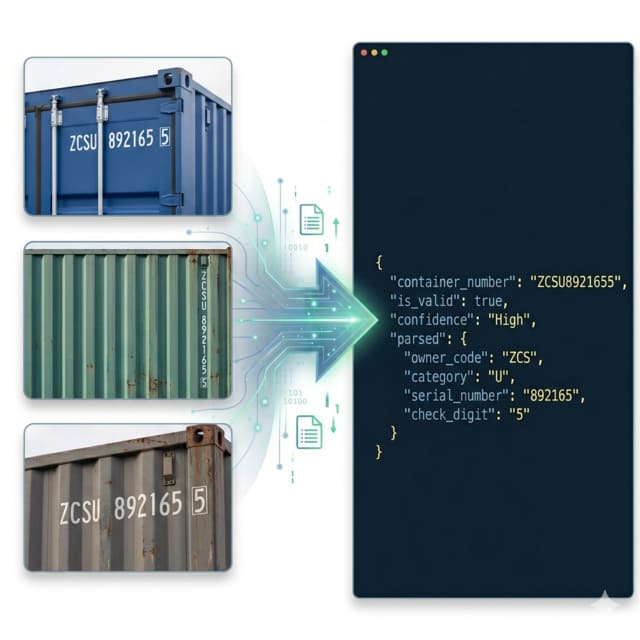
The Reality of Terminal Gate OCR in Europe
European ports lead the world in automation, utilizing Automated Guided Vehicles (AGVs) and dense stacking yards. Capturing container codes in these environments presents unique challenges: high-speed continuous movement, complex top-down crane angles, and frequent rain, fog, or snow that obscures standard optical scanners. Maintaining ultra-high throughput requires an engine that ignores environmental noise. For a deeper dive into overcoming these specific environmental hurdles, see our core Container OCR capabilities.
StructOCR: Built for High-Density Automated Ports
Engineered strictly as a high-performance REST API to ensure seamless integration into European Terminal Operating Systems (TOS) without heavy SDK dependencies, this endpoint is powered by our Logistics Container OCR engine. It features complete rotation invariance—automatically reading upside-down text from ARMG cranes without pre-processing. The engine applies strict ISO 6346 validation to verify the owner code and calculate the check digit, guaranteeing absolute data integrity.
Live Demo: Container OCR
No registration required. Upload a file to test the extraction.
Drop files here or click to browse
JPG · PNG · PDF · TIFF · up to 500 files · max 4.5 MB each
No document handy?
Core Applications for the European Market
Automated Terminals (Rotterdam / Antwerp)
Process inbound and outbound freight flawlessly. By identifying ISO 6346 container codes instantly as AGVs move through the yard, terminal operations achieve seamless automation. Ready to scale your operations? View flexible pricing, featuring modern payment rails like USDC/USDT to bypass traditional cross-border financial friction for international enterprises.
Trans-European Rail Networks
Deploy across extensive inland rail corridors. The API natively handles the extreme vertical angles and high-speed captures required for moving freight trains across European borders.
Inland Waterway Barges
Track container movements at inland river terminals. Ensure accurate logging of containers loading onto barges along the Rhine and Danube without manual intervention.
Post-Brexit Customs Clearance
Accelerate freight clearance by automatically cross-referencing the visually extracted container number with digital customs manifests in real-time, reducing friction at new border checkpoints.
Technical Specs
- Validation: Built-in ISO 6346 checksum verification.
- European Edge Optimization: Infrastructure is routed through Cloudflare's global edge network, with primary processing nodes in Frankfurt, London, and Amsterdam for ultra-low latency.
- Rotation Invariance: Native support for 0°, 90°, 180°, and 270° orientations without manual pre-processing.
- Input Versatility: Fully supports raw Base64 strings, direct multipart file uploads, and public image URLs for secure internal network integration.
Key Features
- ISO 6346 Parsing: Perfectly isolates the 3-letter Owner Code (BIC), 1-letter Equipment Category, 6-digit Serial Number, and 1-digit Check Digit.
- Harsh Weather Tolerance: Advanced filtering mitigates image noise from rain, fog, dirt, and heavy cloud cover common in Northern Europe.
- Multi-Camera Redundancy: High-throughput capacity supports concurrent API calls from multiple lane cameras capturing the same target, allowing your system to deduplicate based on timestamp and physical lane ID.
Integration & AI Prompts
Call the endpoint directly via HTTP. The API flexibly accepts standard image URLs, direct multipart file uploads, or Base64-encoded strings to minimize network latency on edge networks.
import requests
import base64

# Prepare Base64 Image from local CCTV capture
with open("ccr_rotterdam_gate3.jpg", "rb") as image_file:
    base64_image = base64.b64encode(image_file.read()).decode('utf-8')

url = "https://api.structocr.com/v1/container"
headers = {
    "x-api-key": "YOUR_API_KEY",
    "Content-Type": "application/json"
}
payload = {
    "img": base64_image
}

try:
    print("Scanning Gate Capture...")
    response = requests.post(url, headers=headers, json=payload)
    result = response.json()

    if result.get('success'):
        data = result['data']['parsed']
        print("✅ Container Code Extracted!")
        print(f"Full Number:  {data.get('owner_code')}{data.get('category')}{data.get('serial_number')}-{data.get('check_digit')}")
        print(f"Valid ISO:    {data.get('is_valid')}")
        print(f"Confidence:   {result['data'].get('confidence')}")
    else:
        print(f"❌ Extraction Failed: {result.get('error')} - {result.get('message')}")

except Exception as e:
    print(f"An error occurred: {e}")
Standardized JSON Output
The API returns a cleanly parsed payload breaking down the ISO 6346 components, validating the check digit, and providing a structural confidence score.
{
  "success": true,
  "data": {
    "container_number": "ZCSU8921655",
    "is_valid": true,
    "confidence": "High",
    "parsed": {
      "owner_code": "ZCS",
      "category": "U",
      "serial_number": "892165",
      "check_digit": "5"
    }
  }
}
Frequently Asked Questions
Can I test the API with my own images for free before subscribing?
Yes! You can utilize our free image test directly on the platform to upload your own challenging captures (via direct file upload or URL) and instantly verify the extraction accuracy.
How does the API ensure low latency for European operations?
Our core architecture is deployed on Cloudflare, meaning API requests from European terminals are routed through local edge nodes (such as Amsterdam and Frankfurt), minimizing t1 and t2 latency for mission-critical gate automation.
Does sending images to the API violate strict data privacy requirements?
The API accepts Base64-encoded strings and direct file uploads, meaning you do not need to host sensitive images publicly. Furthermore, images are kept for at most 24 hours for quality spot-checks, then deleted.
Explore More Container Solutions
Container OCR API for Intermodal Rail
Automate intermodal rail operations with our high-accuracy Container OCR API. Upload rail yard captures to test our ISO 6346 extraction for free. Built for high-speed logistics.
Container OCR API for ERP
Integrate container OCR data directly into your ERP system. Upload logistics photos to test our ISO 6346 extraction for free and eliminate manual data entry.
Container OCR API for TOS Integration
Integrate high-accuracy Container OCR directly into your Terminal Operating System (TOS). Upload terminal CCTV captures to test our ISO 6346 extraction for free.
Container OCR API for WMS
Automate your Warehouse Management System (WMS) receiving process. Upload loading dock captures to test our high-accuracy Container OCR API for free.
Container OCR API for YMS
Automate your Yard Management System (YMS) with our high-accuracy Container OCR API. Upload yard captures to test our ISO 6346 extraction for free.
Container OCR API for Gate Automation
Automate terminal gates with our high-accuracy Container OCR API. Upload your own CCTV images to test our ISO 6346 extraction for free. Built for moving vehicles.
Container OCR API Australia
High-accuracy ISO 6346 container number extraction for Australian ports and intermodal yards. Upload your image for a free test today to see instant results.
Container OCR API for Intermodal Rail
Automate intermodal rail operations with our high-accuracy Container OCR API. Upload rail yard captures to test our ISO 6346 extraction for free. Built for high-speed logistics.
Container OCR API
Extract ISO 6346 container numbers from challenging terminal environments. High-accuracy OCR featuring 180-degree rotation invariance and shadow mitigation.
Container OCR API Malaysia
Automate Port Klang and local logistics yards with our robust Container OCR API. Upload a challenging container image for a free accuracy test today.
Technical Comparisons & Integrations
Explore platform integrations and competitive analysis
Add Container OCR to Your Bolt.new App in 5 Minutes
Step-by-step guide to integrating the StructOCR shipping container API into a Bolt.new app. Build logistics and yard management tools right in your browser.
Add Container OCR using Cursor in 5 Minutes
Step-by-step guide to integrating the StructOCR shipping container API using the Cursor AI code editor. Build logistics and yard management tools rapidly.
Google Cloud Vision vs. StructOCR API for Shipping Containers
Comparing generic enterprise OCR solutions like Google Cloud Vision against StructOCR's purpose-built API for ISO 6346 shipping container recognition.
Add Container OCR to Your Lovable.dev App in 5 Minutes
Step-by-step guide to integrating the StructOCR shipping container API into a Lovable.dev app. Build logistics and yard management tools with zero backend.
Manual TOS Entry vs. Container OCR Automation API
Analyzing the ROI and operational efficiency of replacing manual gate checkers with an automated Container OCR API in logistics yards.
Add Container OCR to Your Replit App in 5 Minutes
Step-by-step guide to integrating the StructOCR shipping container API into a Replit application. Build logistics and yard management tools using Replit Agent and Secrets.
From tutorial to production in 5 minutes.
You've seen the code. Now get your API key, grab your 200 free credits, and see it work with your own images. No credit card required.